Virtual Valerie is a point-and-click game developed by Mike Saenz, CEO of Reactor Inc. During the 1980s and 1990s, he developed and published CD-ROMs, including some of the first interactive adult games: MacPlaymate (1986), and Virtual Valerie 2 (1995).

Description
Virtual Valerie (1990) followed MacPlaymate, with a similar structure. The game was marketed by Saenz’s company (Reactor) for $99. In color and featuring a storyline with more context (the player must meet Valerie in a hotel room for a sexual encounter), the game also introduced dialogue with the character. It was marketed as “a sexual date on a disk.”
The game was more developed and offered several options to players: it was possible to move around the entire hotel (five floors and the basement), as well as Valerie’s apartment, where players could launch mini-games—essentially a series of short animations—by interacting with picture frames and the disk player.
The FPS (First Person Shooter) game is more immersive than MacPlaymate: the character played by the player is in a lively street, in front of a hotel. Holding a business card left by Valerie, they are led to enter the building and search for her room. If the player chooses to follow Script 1 (see below), they find Valerie’s apartment and answer “yes” to all her questions while sitting on the couch (during which she gradually undresses). If the player hesitates or refuses some of Valerie’s suggestions, she kicks them out of her suite and the game restarts from the beginning. Otherwise, she invites them to join her in the bedroom, where she gets on all fours and can be penetrated with objects. The player can also choose not to follow this script and instead explore the apartment.
More interactive than MacPlaymate and more cunning in its game mechanics, Virtual Valerie similarly objectifies its protagonist. Men are largely absent from the game, except in two significant instances:
- the male gaze of the omnipotent player;
- a man available behind door one, corpulent, wearing a tank top, whose entry into the game is accompanied by a burp and a remark made in a drawling tone. Everything is done to code this man as repulsive, at least according to Western beauty standards.
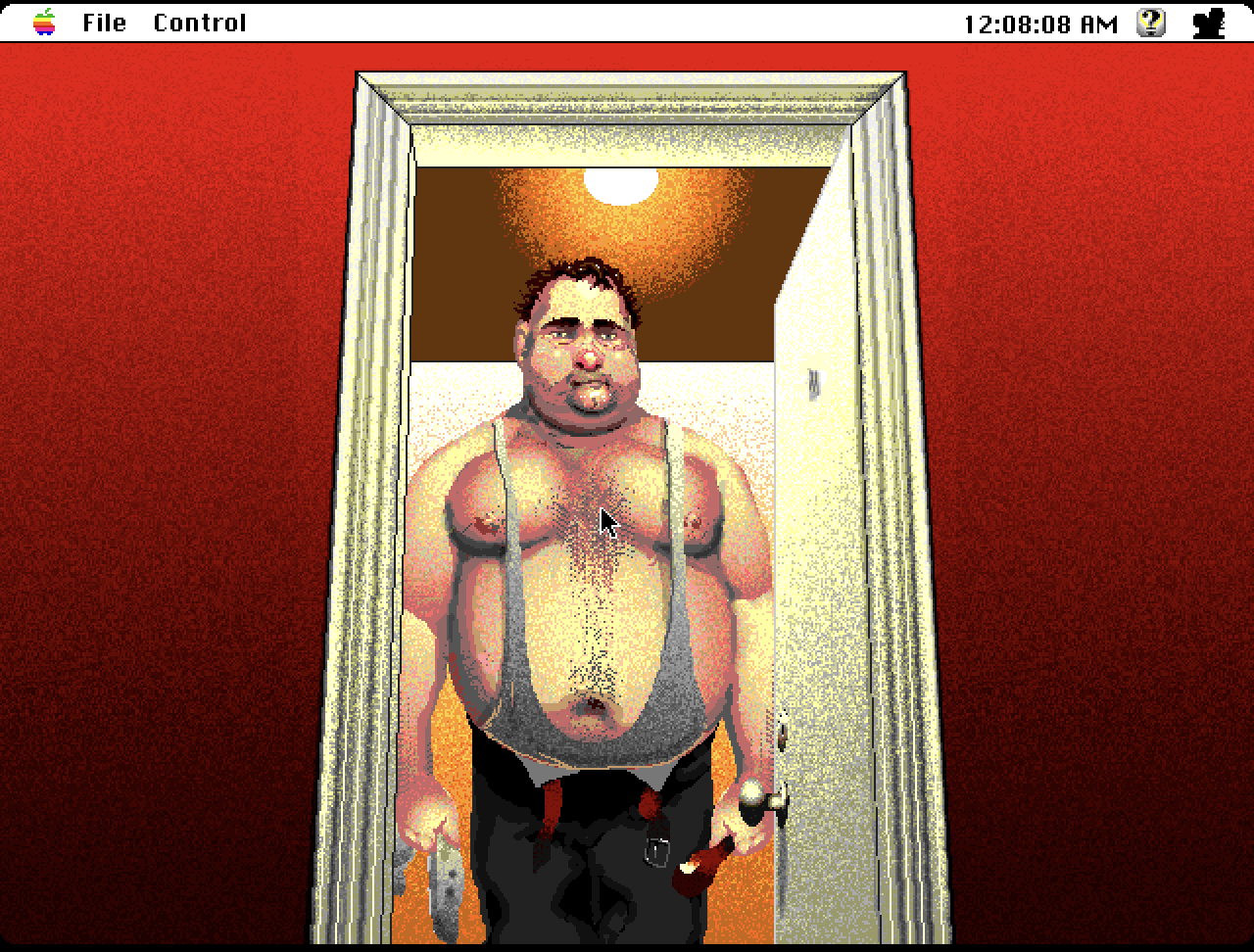
In a certain way, the appearance of the corpulent neighbor functions as a reaffirmation of the player’s central masculinity. The male gaze is assured as a position of power precisely because the player alone enjoys Valerie’s sexual availability. The fact that the only other man in the game is repulsive helps to defuse any latent homosexuality or any desire that doesn’t match the announced heterosexual script.
However, we can also add nuance to these analyses and observe that Valerie is a character who possesses a form of agency. While this agency can be easily manipulated once players (who are targeted as male) understand that only a unilateral ‘yes’ allows access to the next stage of undressing or sexual activity, an idea nevertheless emerges implicitly: only full consent leads to sex. Admittedly, this is the player’s consent, not Valerie’s. Yet the fact that sex is not immediately accessible gives this game a distinctive position within the constellation of erotic video games.