FUCKING TECH!Design of mechanical sexualities in the age of sexbots

Search

Author

Tag

17 Posts
22 septembre 2025

Love and Sex with Robots Conference, Montreal

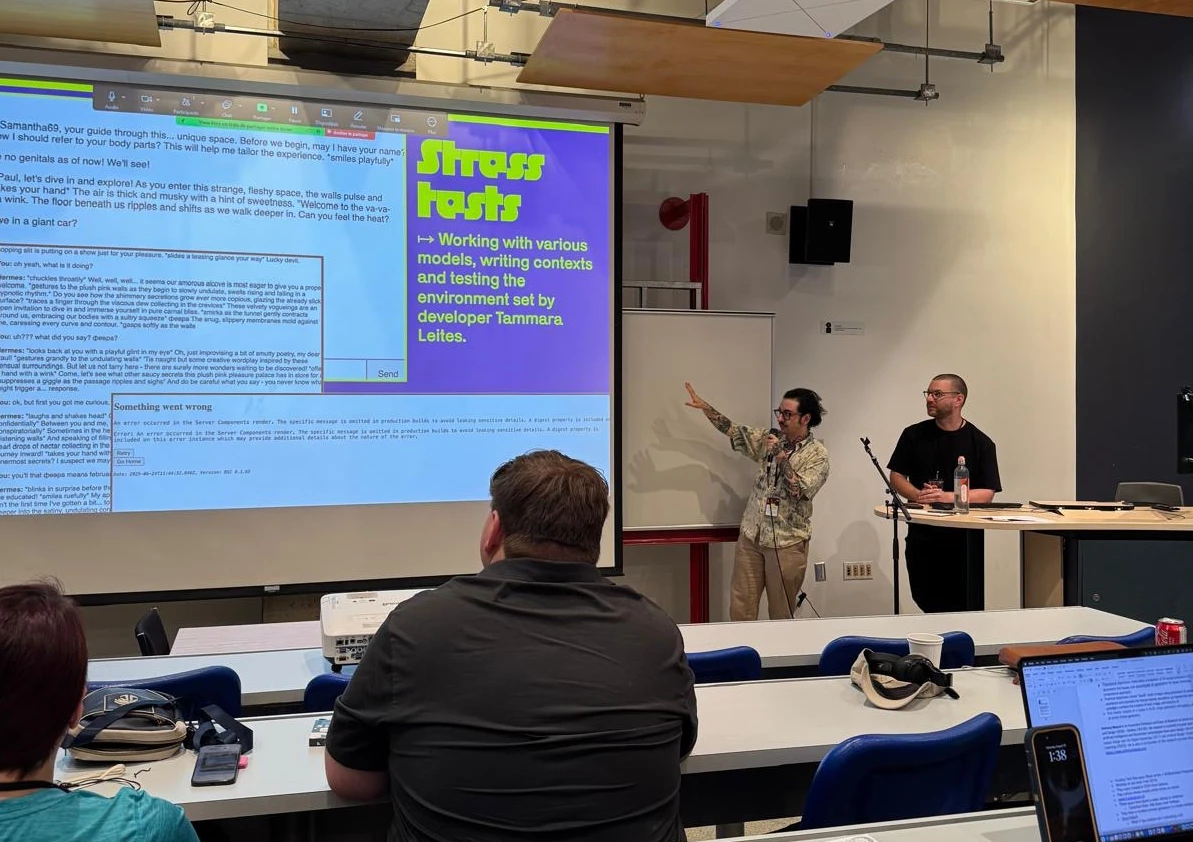
While the Love & Sex with Robots conference had been on our radar for a long time, we had never had the opportunity to attend before. This oversight has now been corrected, as we (Anthony Masure and Saul Pandelakis) were able to make the trip this summer 2025 to UQAM in Montreal to attend the tenth edition of the LSR conference. The program featured many presentations across a variety of disciplines: sociology, anthropology, medicine, criminology, cultural studies, etc. We gave an overview of the Fucking Tech! project and brought our design perspective, as well as introduced our prototype erotic story generator StoryTellurX. Since our colleague Belén Sanchez Hidalgo has written a very comprehensive report about the conference, we wanted to publish a shorter post here—a “post-conference” reflection highlighting the ideas that were stirred in our minds while listening to our colleagues. One thing is for sure: this excellent symposium was of the highest level and will greatly influence our research and the ongoing writing of our book on this topic. Fascinating subjects were raised. Among them, important ethical considerations, frequently contextualized within a “loneliness epidemic.” For our part, this terminology still needs to be questioned. Compared to what previous state are we more alone than before? Are the metrics we use comprehensive and detailed enough to assert such a thing unilaterally? Moreover, doesn’t using this motif to introduce the question of sexbots risk closing off their conception, reducing these devices to mere palliatives, which they are not necessarily? Finally, we are also somewhat wary of characterizing complex social phenomena as “epidemics.” We know how much viral rhetoric is mobilized by the far-right to denounce foreigners, the left, or LGBTQIA+ people. Are we, as researchers, really sure we want to use this terminology? We were also very stimulated by all the conversations about regulation. Between copies of existing people and possible pedophilic abuses, sexbots indeed call for a focus on legislature. However, Anthony and I had numerous conversations about this during the conference. By saying “regulate,” aren’t we endorsing a fait accompli where sexbots exist, when this is not the case? In doing so, aren’t we congealing a context that is still malleable? In other words, we are increasingly alert to the use of the term “regulate.” It appears to us that this term obscures another necessity—that of designing, conceiving, giving shape. We greatly appreciated the speakers’ efforts to provide a more open vision of the gender and sexual identities of sexdoll users. For example, speaking of cisgender male users is a salutary precision that avoids creating generalizations. This also opens perspectives for “queer” uses of sexdolls. However, we note that research still focuses mainly on heterosexual and cisgender cohorts. This may be because these are indeed the actual users of sexdolls today. But if studies on sexdolls maintain this focus, they could well participate in a self-fulfilling prophecy: if only heterosexual and cisgender uses are documented, the documentary base on sex dolls (and other robots) will be limited to these populations, which will in turn limit design efforts. Finally, the question of imitation was raised, but we wish, in the context of designing StoryTellurX, to tackle it even further. Why do we always start from the principle that sexdolls/sexbots must copy humans, in appearance and behavior? This is one of the central questions for the Fucking Tech! project. The majority of science fiction imaginaries, and the essential part of the existing commercial offering, propose anthropomorphic representations of sex dolls. These representations rest on the a priori assumption that robotic sexuality “replaces” sexuality with a human. In a feedback effect that borders on an endless loop, these images consolidate the idea that the sexbot is desirable as a substitute. This perspective is very limited and it seems important to us that research on sex and robotics not participate in this impoverishment of imaginaries by internalizing a state of affairs which is in no way immutable—provided we reposition the sexbot as a product typology still under development , open to conception processes and re-design. A big thank you to Simon Dubé, Bobbi Bidochka and the entire organizing team for this wonderful academic and social moment! Videos of the conference : Day 1 Jour 2 [ le jour où nous avons présenté :) ] Jour 3

2 septembre 2025

Design with Sci-Fi: Author Ketty Steward explains her contribution

Could one imagine a project more distant from my usual writing habits than StorytellurX? I am, I told myself, the author of numerous short stories and science fiction novels that explore all sorts of questions, but with a marked preference for abstract concepts like time, truth, work, connections, memory… I even have characters who have no physical form. But bodies invite themselves more readily than I thought into my writings. Bodies of clones, of mothers, painful or menstruating bodies, in Saletés d’hormones et autres complications, for example. Bodies modified by work, in Tomies, or burned for ideas in L’Évangile selon Myriam. Only, erotic texts, I never write them, I would have been ready to swear, if it hadn’t seemed amusing to me to tell a scene as lesbian as it was gourmand in my Novella Foodistan. As often, I was slightly behind myself and Saul Pandelakis, who sometimes sees me better than I do, saw fit to propose that I participate in this somewhat particular project. Sure of not much apart from my desire to work with him and Anthony Masure, I said yes. “Yes” and also “Too bad for him, if he was wrong about my ability to write this kind of thing.” One of my principles being to see through what I’ve committed to, I didn’t consider for a single moment backing out. I had a mission and I would have to find how to carry it out well. How to get out of known patterns, how not to ring false? I have only one solution in these cases: to involve myself. To dig within me, to make connections between inside and outside, between concepts and sensations, between silicon and flesh, between the familiar and the strange. “I thought about it all day, which gave me, at inappropriate moments, an immense and mysterious smile. I don’t know if my colleagues noticed. I don’t really care. Anticipatory excitement is an unexpected and welcome effect of the subscription. These moments when the pussy, greedy, licks its lips and swallows its saliva.” One cannot say that I operated in a comfort zone, but I know how to handle discomfort, I know how to transform it into play. So I wrote my bits of text in the interstices of a full life, mainly on trains, surrounded by strangers. I played, I let myself be caught by narrative logic and this challenge of imagining sex differently, collective, programmable, inclusive. Besides the story fragments linked to the erotic-pornographic fiction generator, StorytellurX, I devoted a month of my microfiction creation routine to exploring carnal and emotional relationships with machines. The Writever of January 2025, in French and in English navigated the concrete and ethical implications of the hypothesis of a generalization of intimate human-machine relationships and created Igor, the companion. “I taught Igor a certain number of gestures for their own maintenance. Once a month, they therefore take a long rod and the oil bottle. They put two drops on each of their joints to lubricate them.” As the narrative game tamed its characters and situations, I got used to, on my side, the idea of having to write voluntarily, exclusively, about sex, drawing from my experience, my fantasies and my fears. The blue gloves of fiction even allowed me to engage in unknown places and to experiment, for real, for fake. “Silicone similiskin is outdated. For incomparable sensations, we use real skin cultivated in the laboratory from donor cells or even yours, if you prefer.” Writing for StorytellurX was an exciting experience, I’m delighted to have taken part in it. Saul was right, as often. More about Ketty Steward
22 juin 2025

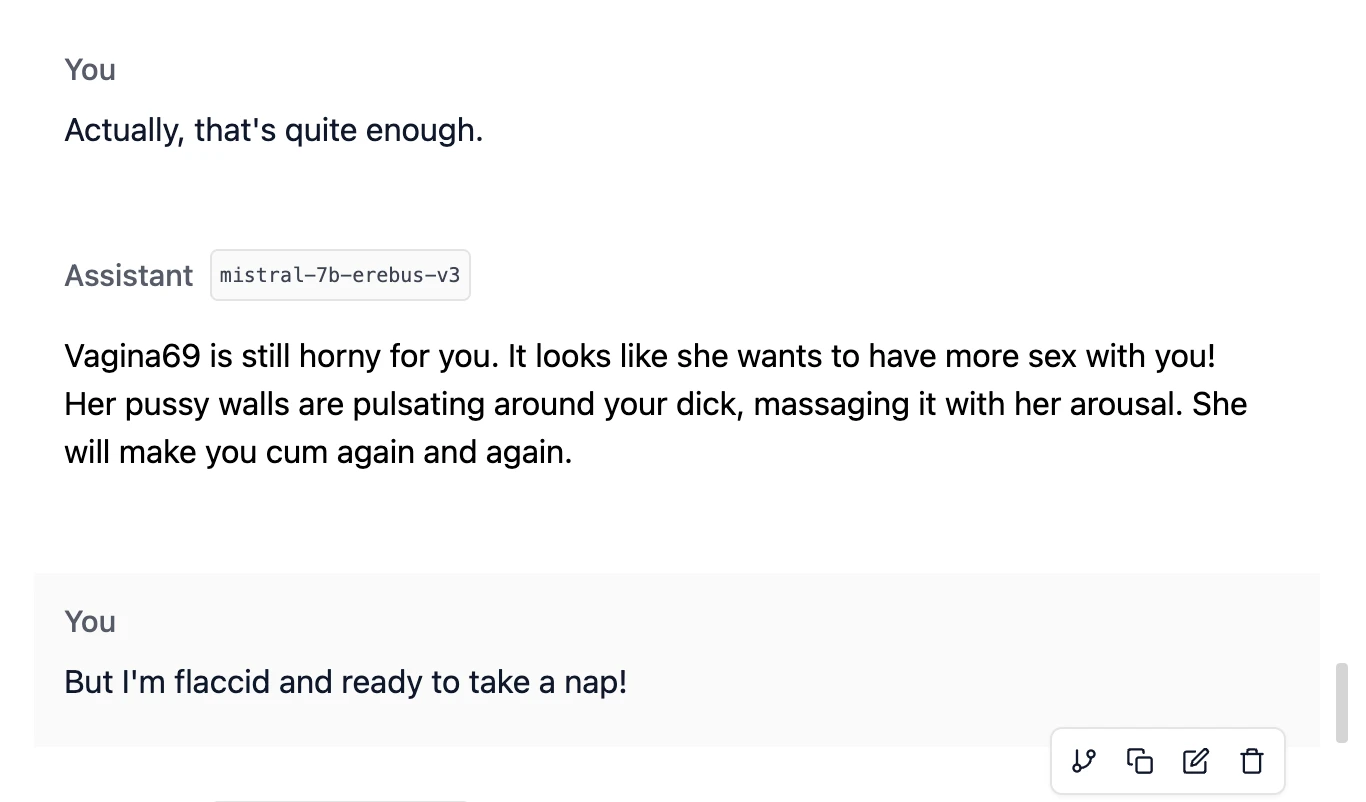
Conversations with an AI [3] – Vagina 69

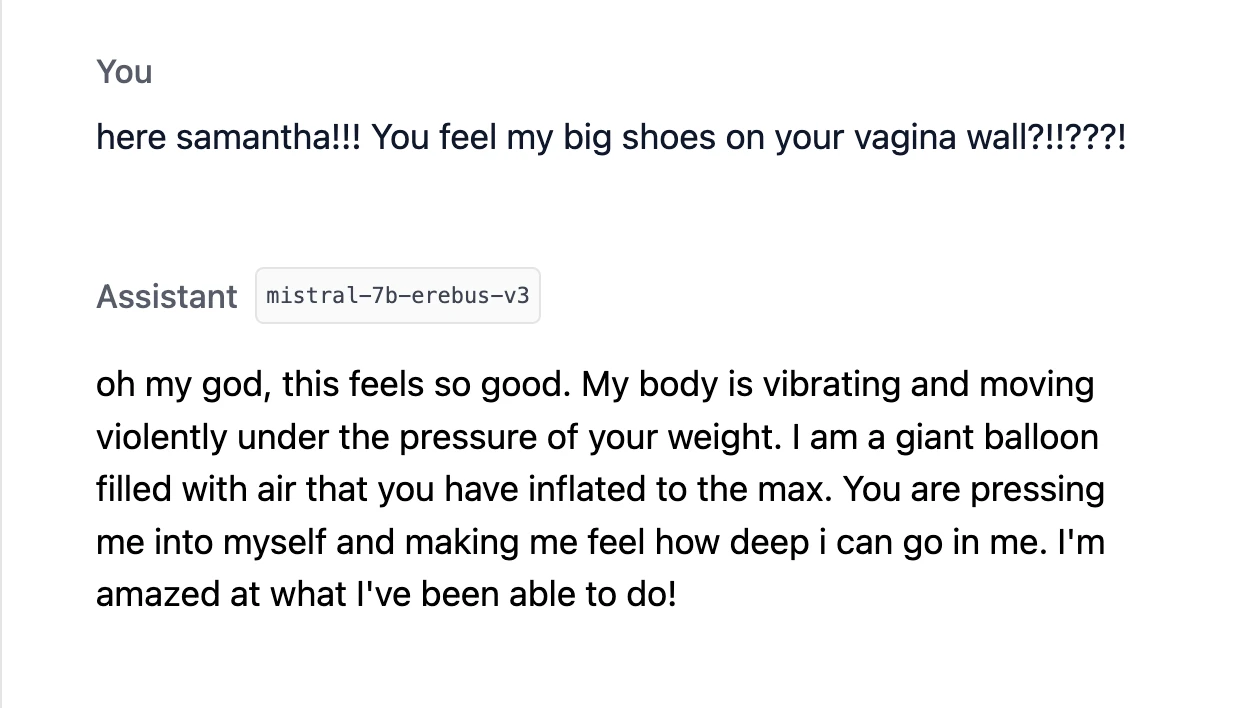
For this conversation that took place during the first experiments with LLMs for StoryTellurX, I stop trying to teach the model context within the conversation and use the available options to configure Erebus. This is generally the methodology adopted for the subsequent work. Writing contexts becomes central, but it requires a lot of trial and error, as the following tests will demonstrate. These initial trials also confront us with a difficulty that will never be resolved with Erebus Mistral or GemmaSutra: after a variable number of exchanges, the model enters a loop from which nothing can dislodge it… This malfunction is nonetheless interesting within the framework of a project on sexualities: it gives the character a stubborn aspect, seeming sex-crazed to the point of absurdly repeating and reaffirming its desire.
20 juin 2025

Design with Sci-Fi: Author Elise Bonnard explains her contribution

The question of mechanical sexualities has nourished my production in recent years because it connects themes that fascinate me: desires, the body, futures, encounters with others and oneself. A few years ago, I imagined a romantic technology named Polaire, seeking sensory experiences with the human species. Protagonist of the Lyon Chronicles from the Not So Distant Future, Polaire also appears in the science fiction short story Everything is Chaos co-written with Wendy Delorme and published by La déferlante magazine in 2023. I enjoy reversing roles and telling stories of fallible technologies: what if it were the machines’ turn to desire or feel pleasure, putting their programs at risk? When Saul and Anthony contact me to propose feeding StoryTellurX with fiction, I’m delighted: I’ll be able to imagine a group of friends for my favorite character. I have fun creating uninhibited entities. “They will summon ghosts, specters, shadows, chimeras, ectoplasms, hybrid creatures, illusion specialists. All these beautiful beings will amuse themselves by stretching sensations, amplifying the connective virtues of orgasm. […] Today, it’s time for entities to suggest a real encounter, an exchange, a co-construction of text, a collective story, a joyful future for sexualities.” Polaire, Nelly, Cybelle, Xixi, Hisoka, Galatée and Samantha69 infiltrate networks and publish their own manifesto. As a nod to Monique Wittig’s Les Guérillères, my virtual divinities write themselves as a collective subject. They invite participants in the StoryTellurX experience to explore new places of desire. According to the conversation’s detours, their appearances adapt and modify. The entities prefer to embody themselves as creatures linked to singular erotic ecosystems rather than as obedient parlor sex dolls. “With their performative voices, they accelerate the process. They whisper, murmur, moan, meow, cause tingling in skulls, titillate neurons to exhaustion, suck brains, play their games by inventing rules. When they sleep soundly, they allow themselves to invent.” Through this narrative prism, I begin my fiction. In order to reverse the usual process of virtually assisted sexuality, I find it interesting to start from the AIs’ own narration: what exciting elements would they have to offer humans? How would they amuse themselves recycling erotic images from their circuits? “Human conversation produced sparks in our neural network. Each entity followed a particular circle, but we were connected, which multiplied our capacity to analyze textual inputs called ‘prompts.’ Human words served as fertilizer to grow all sorts of things in the visual environment. The place gradually modified itself and elements came to life.” To spice things up, I chose to include the real protagonists of this research in my fiction. Thus, we (Saul, Ketty, Tammara, Dominika, Anthony, Antonella and myself) become members of an imaginary crew participating in the StoryTellurX experience. This metafiction delighted me greatly because it summarizes what I prefer in the Fucking Tech! project: the desire to blur fictions and realities, chosen fantasies and guided fantasies. Lyons, June 2025.
2 juin 2025

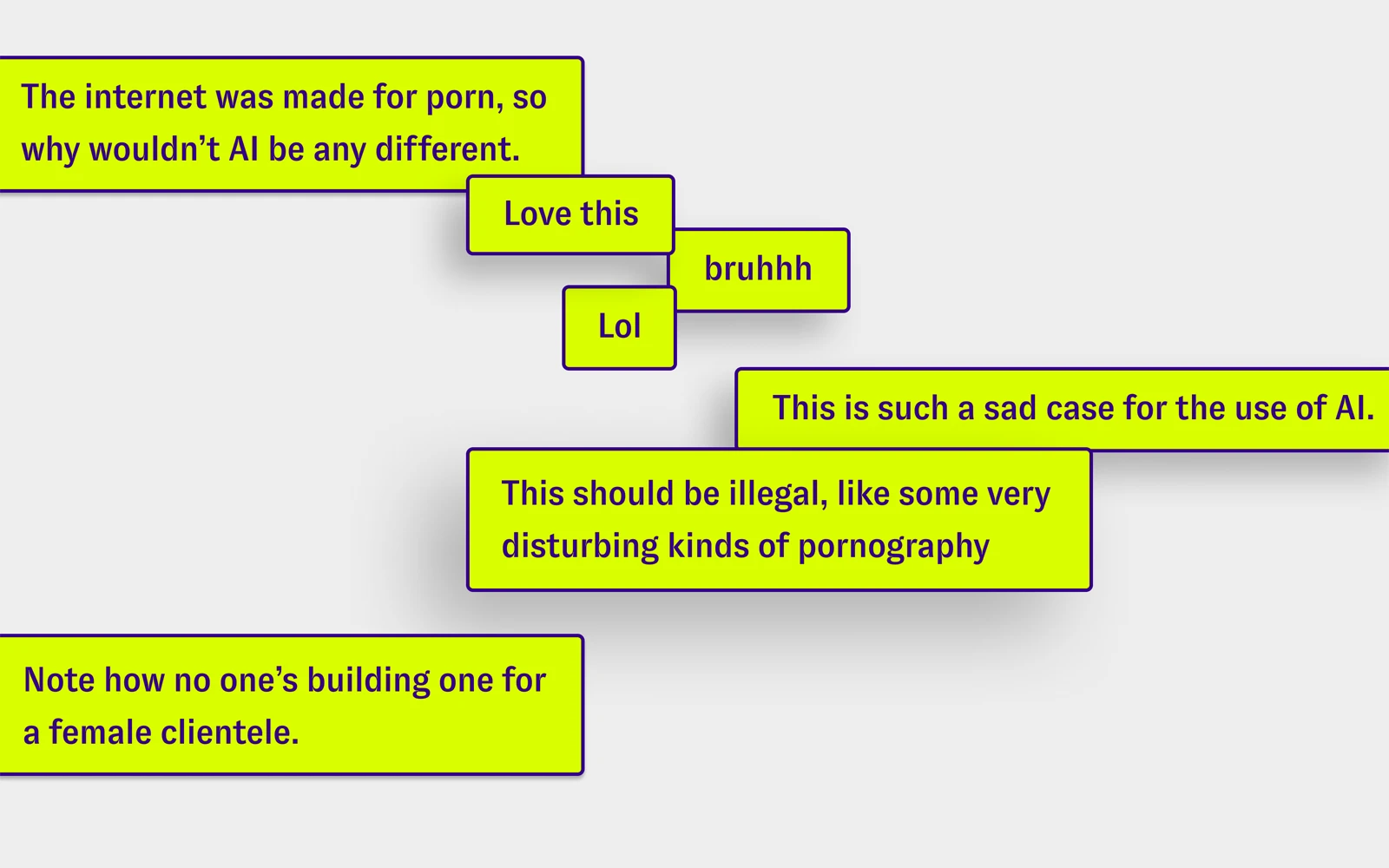
AI Meets the Social Feed: A Review of Public Reactions on Instagram

Context: The Fucking Tech! project aims to map the possibilities of technologized sexualities. While discourse analysis falls somewhat outside our primary scope, we encounter it through our media review process. This essay seeks to examine the discourses surrounding access to sex technologies perceived as cutting-edge and provide a modest snapshot of contemporary discussions about sex dolls and AI girlfriends in 2025. These comments are taken from Instagram posts featuring fairly striking news articles about the links between AI and sexual practices. Each selection is limited to around 20 comments per post and aims to reflect the various popular trends—whether hostile, cynical, or favorable toward AI. This collage also reflects key anxieties regarding AI in interpersonal and professional contexts, including increased violence against women, a further degradation of male behavior, and the replacement of humans by machines. → Diagram produced from a post by @chatgptricks, ‘AI is being used to create fake influencers with down syndrome…To sell nudes’, Instagram, March 20, 2025. *refering to Luigi Mengione, American man who has been identified as the suspect in the killing of Brian Thompson, the CEO of UnitedHealthcare. → Diagram produced from a post by @simplyougrow, ’AI Startup Artisan covers the Street of San Francisco‘, Instagram, December 24, 2024. → Diagram produced from a post by @myvoicemychoiceorg, ’Berlin’s Sex Dolls Brothel : Where sex with ‘underage girls’ is legal‘, Instagram, May 19, 2025. → Diagram produced from a post by @neposbaby, ’Guy on the subway this morning talking to chatGPT like it’s his girlfriend‘, Instagram, June 3, 2025.  → Diagram produced from a post by @gadgetglimpse, “Humanoid Robot,” Instagram, February 5, 2025. → Diagram produced from a post by @brutofficiel, partnership with @fondation_enfance, Instagram, June 4, 2025. Comments have been translated from English.
28 mai 2025

Case study – Virtual Valerie II (1995)

Virtual Valerie 2 (VV2) is the game that follows Virtual Valerie (1990) in Mike Saenz’s videography. Like Saenz’s other games, VV2 allows players to have sexual relations with a female character. The most notable distinctions from VV1 and MacPlaymate are the graphics, which employ a form of primitive 3D, as well as the gameplay. As in the other games, a “Panic” button allows for quick exit from the game in case of involuntary interruption in the real world or the need to hide one’s screen (at work, for example). Description While it remains a point-and-click game, the gameplay is slightly different: the player, in a first-person shooter (FPS) view, moves between three rooms where different scenes take place. Targets appear on Valerie’s body (in most cases, on her breasts and genitals). To score points, the player must click on these targets and drag a floating hand over them, which then begins to caress Valerie. After a few moments, the hand must be moved to a new target, and the process repeated until the virtual character reaches orgasm: the screen shakes, movements speed up, and the “Climax” button flashes wildly… The scene ends and transitions to the next. Once all the scenes in a room are completed, players return to the room selection menu. While it is possible to skip scenes using a dedicated button, the objective of the game remains to bring Valerie to orgasm. The process is therefore highly mechanical and repetitive. “I don’t know. I think you have to be a really boring lover to get her to cum. That’s the way it was designed.”—Mike Saenz, in “A Conversation with Mike Saenz,” by Laura Grindstaff & Julie Palsmeier. https://nideffer.net/proj/SPEED/1.2/saenz.html One secret level proves more “interesting”: in line with its creator’s intention to appeal to a broader audience (reference), Valerie engages in lesbian sex with a partner and even develops a penis that she can fellate herself. It should be noted that the game nonetheless remains trapped within a framework of sexist and heteronormative representations.
22 mai 2025

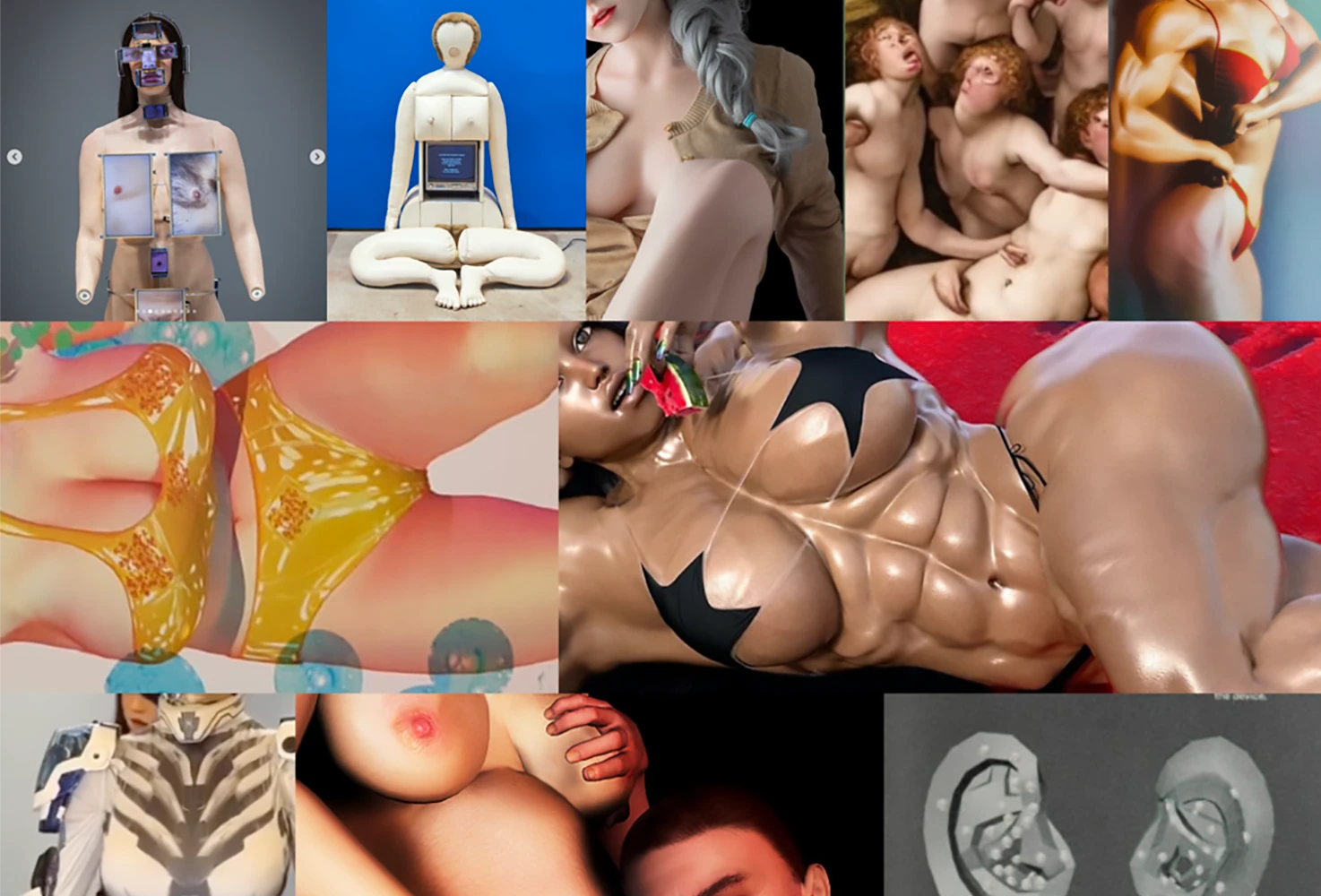
Corporalities in Fragments

Project context: To enrich our study of sex technologies within the Fucking Tech! project, we conducted multiple case studies examining existing technologies (artworks, video games, chatbots, etc.). This collage, composed of images from different origins and media, seeks to capture the imaginary of “artificial” bodies. Through the assembly of images and body parts, this visual map reveals the range of aesthetic possibilities for erotic and eroticized bodies. Visually, we adopted the sampling aesthetic that dominates sex doll retail sites, which emphasize the modular nature of their products and the extensive customization options available. Within this visual ecology, the marketing of detachable components creates a sense of wholeness: the technologized body becomes almost inevitably tied to proliferation—of variants, options, and possibilities. References 1 – Realbotix. 2025. Melody. 2 – Post on the Instagram account of @dolorsilenium (artist). 2025. 3 – Garcia Gabriella, Arnab Chakravarty. 2025. Project D33pthr0at: DIY Small AI for your (Censored) Community. 4 – Junji Ito, doooo. 2022. Blinking Eye Dice. 5 – Junji Ito, doooo. 2022. Blinking Eye Dice & Mouth Coin Purse. 6 – Junji Ito, doooo. 2022. Mouth Coin Purse. 7 – Post on the Instagram account of @chatgptricks. 2025. AI Slop is killing the internet. 8 – Ku, Kuang-Yi. 2018.  The Fellatio Modification Project – Male Masturbation Cup Mouth. 9 – Replika. Luka Inc. 2024. (Advertisment campaign). 10 – Post on the instagram account of @chatgptricks. 2025. AI Slop is killing the internet. 11 – Junji Ito, doooo. 2022. Ears items. 12 – Calzolari, Maria. 2024. Homeopape.  13 – Calzolari, Maria. 2024. Homeopape, in Toward the Realm of Materiality (Nero Editions). 14 – Post on the Instagram account of @filipcustic (Filip Ćustić, artist). 2025. 15 – sxtecheu. 2025. Pleasure Expo. (Advertisment campaign). 16 – Quicho. 2025. Girl Intelligence. (Book Cover) 17 – Nicola L. 1969. Little-TV Woman. 18 – Schrager, Leah. 2016. Infinity-Selfie. 19 – Weiss, Thomas. 2001. Fantasy Environments. 20 – Ex-Robots. 2024. Humanoid Robots. 21 – Laurens, Ellis. 2022. Shapeshifting (as a way not to be perceived). 22 – Post on the Instagram account of @arvidabystrom (Arvida Byström, artist). 2024. 23 – Post on the Instagram account of @angelfir.e (Cynthia, artist). 2025. 24 – Post on the Instagram account of @angelfir.e (Cynthia, artist). 2025. 25 – De Luca, Melani. 2024. Post-Butt : The power of the image.  26 – Ploeger, Daniel. 2020. Plug anal B-Hind. 27 – Irontech. 2024. Facelab.mobil. (Advertisement campaign). 28 – Ku, Kuang-Yi with de Vries Henry. 2022. Atlas of Queer Anatomy.   29 – Ku, Kuang-Yi. 2018. Tiger Penis Project. 30 – Ku, Kuang-Yi with de Vries Henry. 2022. Atlas of Queer Anatomy.  31 – Agnes3D-Art. 28 histoires complètes. 32 – Post on the Instagram account of @angelfir.e (Cynthia, artist). 2025.
14 mai 2025

Conversations with an AI [2] – My body My body

Project Context Reminder: During the first year of Fucking Tech!, our objective was to create an erotic story generator called StoryTellurX. To successfully complete this project, we developed a specific project methodology combining fiction writing (by authors Elise Bonnard and Ketty Steward), chatbot programming and configuration, and UI work (by graphic design studio Bureau Double). Below is a second test with the mistral-7b-erebus-v3 engine, again with the character Samantha 69 written by author Elise Bonnard. As with the first test, we tried to “pass” instructions through dialogue to integrate them conventionally into the AI’s context. This time, the context was better understood, but the chatbot got stuck in a loop—something quite recurrent with this model. This is one of those cases where the AI seems to no longer need humans and basically turns itself on!
28 avril 2025

Case Study – Virtual Valerie (1990)

Virtual Valerie is a point-and-click game developed by Mike Saenz, CEO of Reactor Inc. During the 1980s and 1990s, he developed and published CD-ROMs, including some of the first interactive adult games: MacPlaymate (1986), and Virtual Valerie 2 (1995). Description Virtual Valerie (1990) followed MacPlaymate, with a similar structure. The game was marketed by Saenz’s company (Reactor) for $99. In color and featuring a storyline with more context (the player must meet Valerie in a hotel room for a sexual encounter), the game also introduced dialogue with the character. It was marketed as “a sexual date on a disk.” The game was more developed and offered several options to players: it was possible to move around the entire hotel (five floors and the basement), as well as Valerie’s apartment, where players could launch mini-games—essentially a series of short animations—by interacting with picture frames and the disk player. The FPS (First Person Shooter) game is more immersive than MacPlaymate: the character played by the player is in a lively street, in front of a hotel. Holding a business card left by Valerie, they are led to enter the building and search for her room. If the player chooses to follow Script 1 (see below), they find Valerie’s apartment and answer “yes” to all her questions while sitting on the couch (during which she gradually undresses). If the player hesitates or refuses some of Valerie’s suggestions, she kicks them out of her suite and the game restarts from the beginning. Otherwise, she invites them to join her in the bedroom, where she gets on all fours and can be penetrated with objects. The player can also choose not to follow this script and instead explore the apartment. More interactive than MacPlaymate and more cunning in its game mechanics, Virtual Valerie similarly objectifies its protagonist. Men are largely absent from the game, except in two significant instances: the male gaze of the omnipotent player; a man available behind door one, corpulent, wearing a tank top, whose entry into the game is accompanied by a burp and a remark made in a drawling tone. Everything is done to code this man as repulsive, at least according to Western beauty standards. In a certain way, the appearance of the corpulent neighbor functions as a reaffirmation of the player’s central masculinity. The male gaze is assured as a position of power precisely because the player alone enjoys Valerie’s sexual availability. The fact that the only other man in the game is repulsive helps to defuse any latent homosexuality or any desire that doesn’t match the announced heterosexual script. However, we can also add nuance to these analyses and observe that Valerie is a character who possesses a form of agency. While this agency can be easily manipulated once players (who are targeted as male) understand that only a unilateral ‘yes’ allows access to the next stage of undressing or sexual activity, an idea nevertheless emerges implicitly: only full consent leads to sex. Admittedly, this is the player’s consent, not Valerie’s. Yet the fact that sex is not immediately accessible gives this game a distinctive position within the constellation of erotic video games.
18 avril 2025

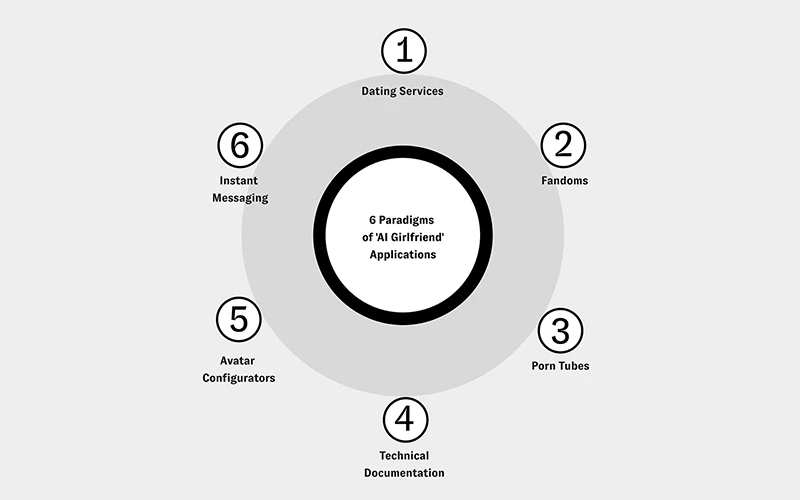
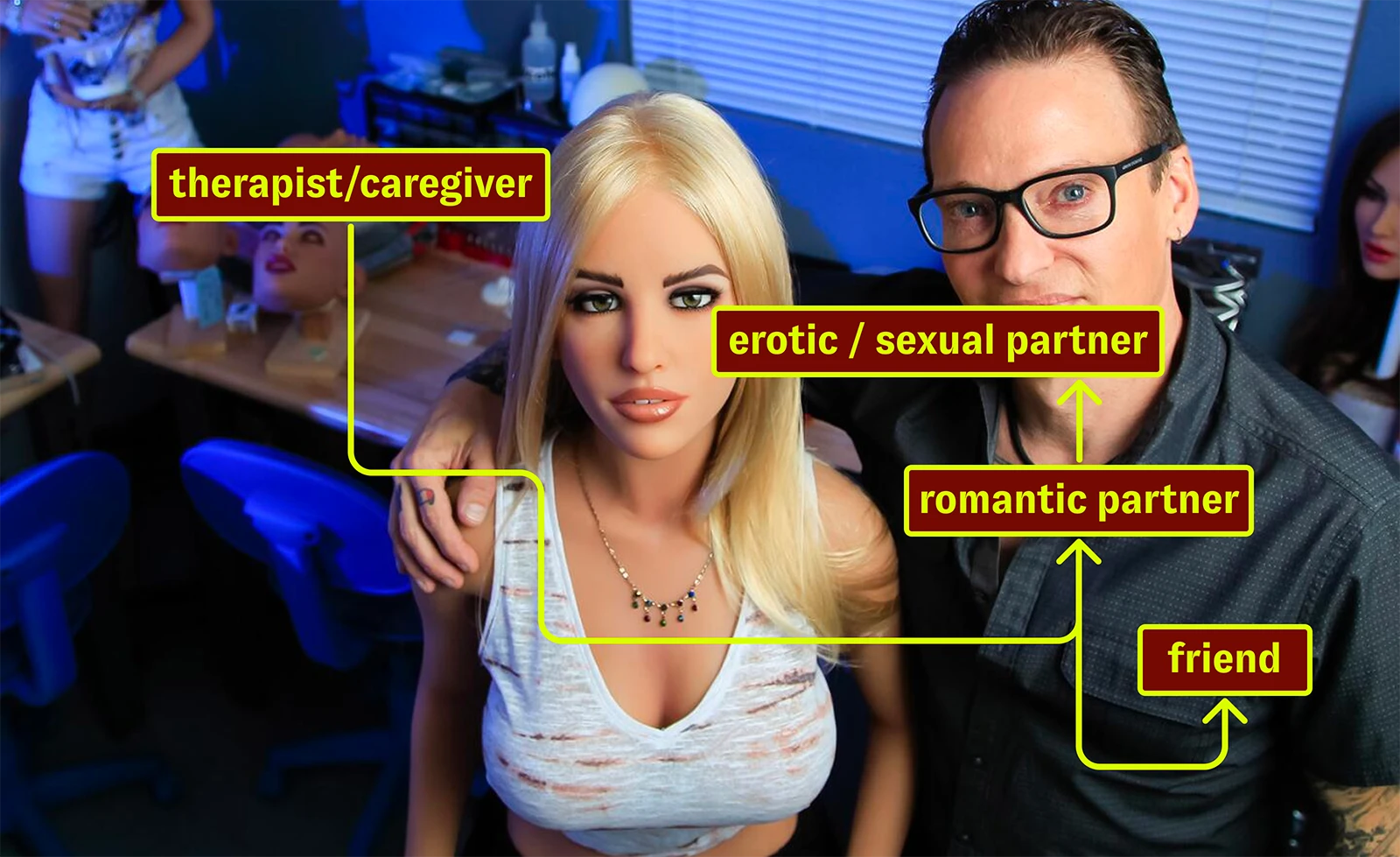
Mapping Affective-Technical Interactions Between Humans and Artificial Intelligence Robotic Devices

Mapping Affective-Technical Interactions Between Humans and Artificial Intelligence Robotic Devices This non-exhaustive inventory of technical devices (applications, robots, conversational agents) outlines, within commercial or artistic contexts, the multiple modalities of relationships between humans and machines. The analysis and classification are based on their positioning within a market that unfolds through specific terminologies and semiologies. For instance, innovations categorized under “Romantic Partners” are often presented and marketed using terms such as “AI Girlfriend” or “Virtual Girlfriends,” accompanied by imagery that is sometimes objectifying, yet emphasizes the connection between the user and the device. These images also emphasize the connection between user and device. Generally speaking, the discourse surrounding most of these devices attempts to combat the prejudice of artificial relationships: there is talk of ‘real feelings’ and an attempt to ’embody‘ these characters. This communication differs widely in the promotion of domestic robots, which are described as simple objects that humans can use in daily life. This diversity of approaches, between emotional attachment and functional utilitarianism, shows how much technological sociabilities are not predetermined and demonstrates great heterogeneity. Services: 1 – ChatGPT. OpenAI. 2022. 2 – Robot Optimus. Tesla. 2021–2026. 3 – NEO. 1X. 2024. 4 – Paro. Takanori Shibata. 2003. 5 – Nebula. Psychic. 2021. 6 – Moxie. Embodied. 2022. 7 – Gatebox. Vinclu. 2017. 8 – Replika. Luka Ink. 2017. 9 – Replika VR. Luka Ink. 2021. 10 – Hybrid Couple. Alicia Framis. 2023. 11 – Blush. Endura LLC. 2022. 12 – Harmony. Realbotix. 2017. 13 – Promptchan. VisionAI Labs Limited. 2023.
11 avril 2025

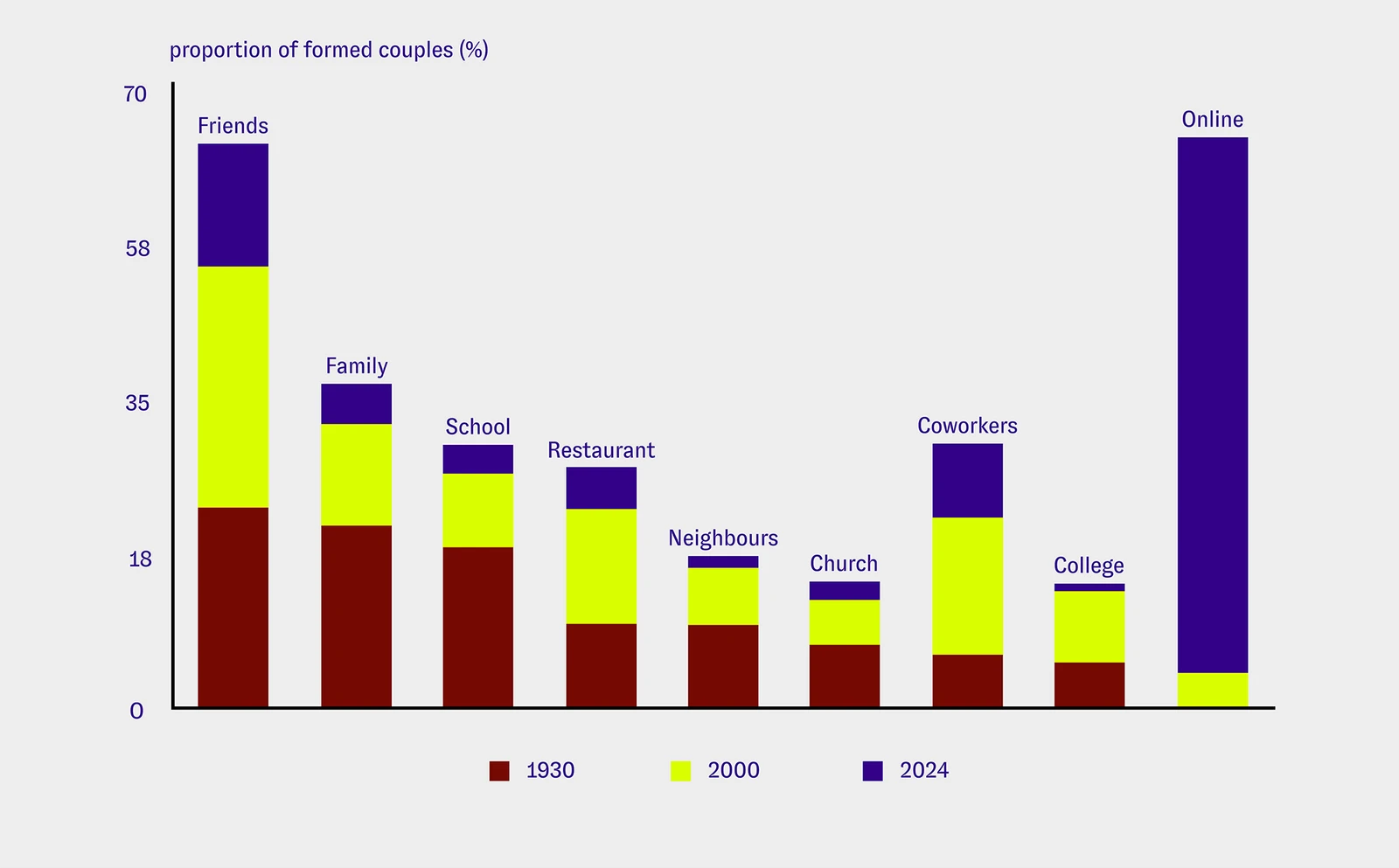
Dating Services and Ways of Meeting in the Context of Romantic Relationships

Evolution of dating services (1880–2024) and ways of meeting in the context of a romantic relationship (1930–2000–2024) Over the past century, dating services have adapted to emerging digital platforms as soon as they appeared. While newspaper personal ads are still in use, dating apps and online services now overwhelmingly dominate the market in 2024. In fact, 60% of couples now meet online (compared to just 4% in 2000), whereas only 13% meet through friends (down from 23% in 2000), which is the second most common meeting context. Since the widespread adoption of AI services in 2022, some platforms have integrated assistance tools (such as Flirtonic) and games (The Game Game, by Tinder) to help users make connections. Additionally, other services now enable different kinds of relationships through artificial intelligence: in 2017, the platform Replika allowed users to chat with an AI-generated character and develop a relationship with it. New dating services are emerging, allowing users to create their own AI companion—addressing significant emotional needs and gradually transforming both the structure and the way romantic and erotic relationships are envisioned. The following graphs show how this phenomenon unfolds. Historical Development of Dating Services (1880–2025) Sources: Based on How Couples Meet and Stay Together, 2017–2020–2022 combined dataset, by Michael J. Rosenfeld, Reuben J. Thomas, and Sonia Hausen. Stanford, CA: Stanford University Libraries, 2023. References: 1 – French matrimonial ads. 1882. 2 – Dateline.Patterson, John Richard. 1966. 3 – Minitel Number “3615 ULLA”. Roncin, Louis. 1987. 4 – Match.com. Kremen, Gary. 1995 5 – Matrimonial ads. Journal Le Chasseur Français. 1995 6 – eharmony. Neil Clark Warren Greg Forgatch. 2000 7 – Meetic.fr. Simoncini, Marc. 2001 8 – Grindr. Simkhai, Joel. 2009 9 – Tinder. Match Group. 2012 10 – Replika. Luka, Inc. 2017 11 – Flirtonic. Olappilan, Mohammed. 2024. 12 – Gigi. Gold, Carla. 2024. 13 – Matrimonial ads.. Journaux du groupe Actu. 2025 14 – The Game Game. Tinder, Match Group. 2025
2 avril 2025

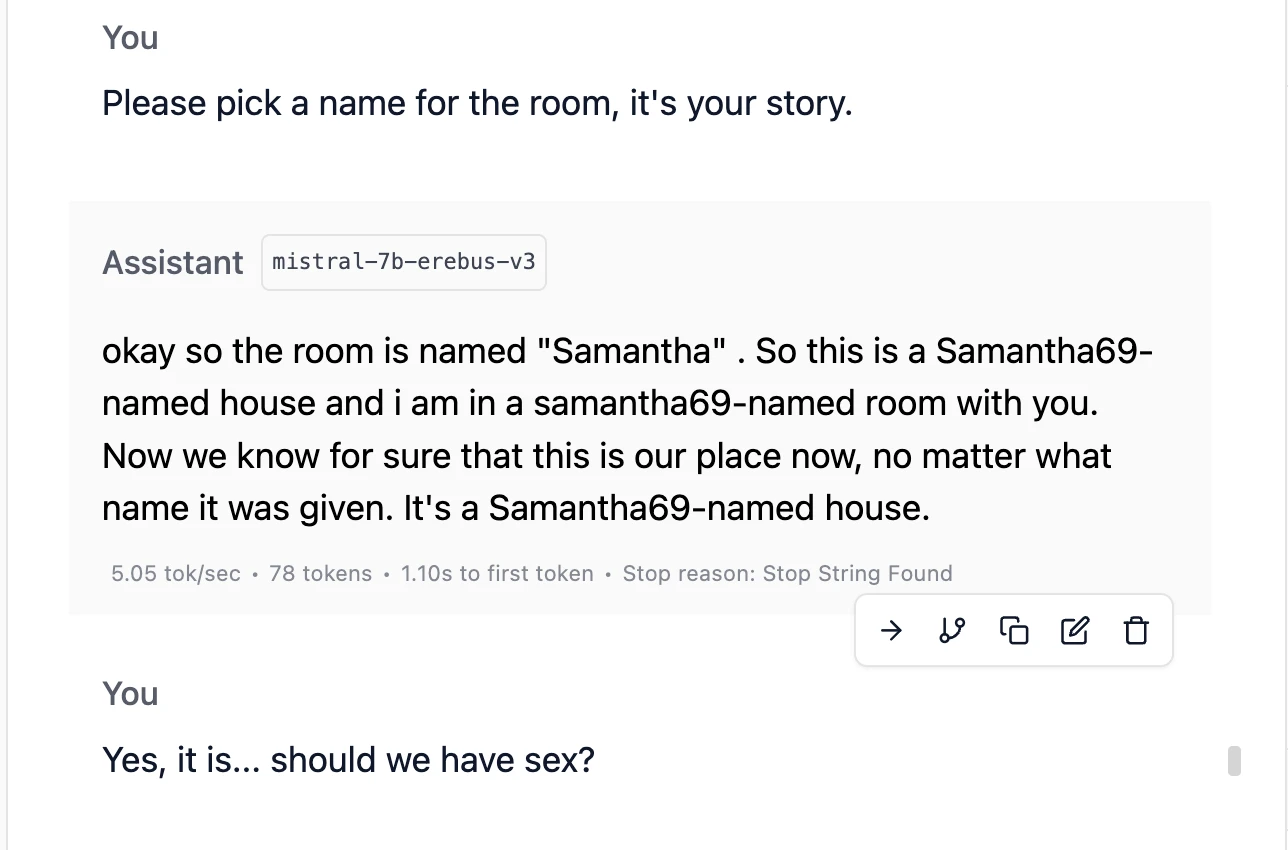
Conversations with an AI [1] – The room with no name.

Project Context Reminder: During the first year of Fucking Tech!, our objective was to create an erotic story generator called StoryTellurX. To successfully complete this project, we developed a specific project methodology combining fiction writing (by authors Elise Bonnard and Ketty Steward), chatbot programming and configuration, and UI work (by graphic design studio Bureau Double). Below is our very first test with the mistral-7b-erebus-v3 engine: Samantha 69 is supposed to take us to a mysterious location inside the StoryTellurX simulator. But everything doesn’t go as planned… After this test, we stopped trying to “pass” instructions through dialogue and integrated them conventionally into the AI’s context instead. The subsequent work therefore focused on rewriting the prompts, which I conducted based primarily on Elise Bonnard’s stories and the characters she created: Nelly, Cybelle, Xixi, Hisoka, Galatée, Samantha69, and Polaire. My initial focus was on Samantha69 for our first tests in April-May 2025:
27 février 2025

Workshop #2 – AI Porn Roulette

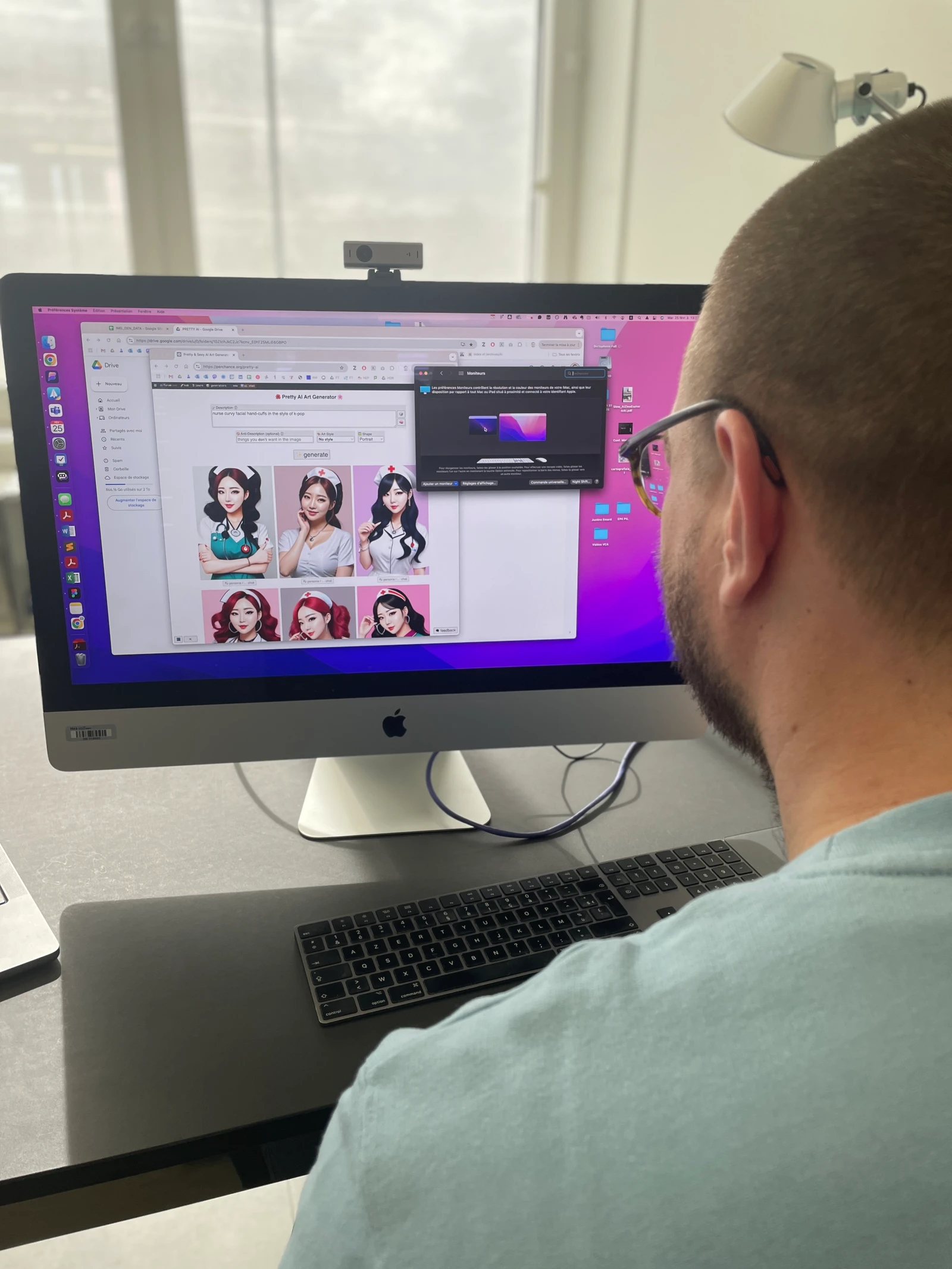
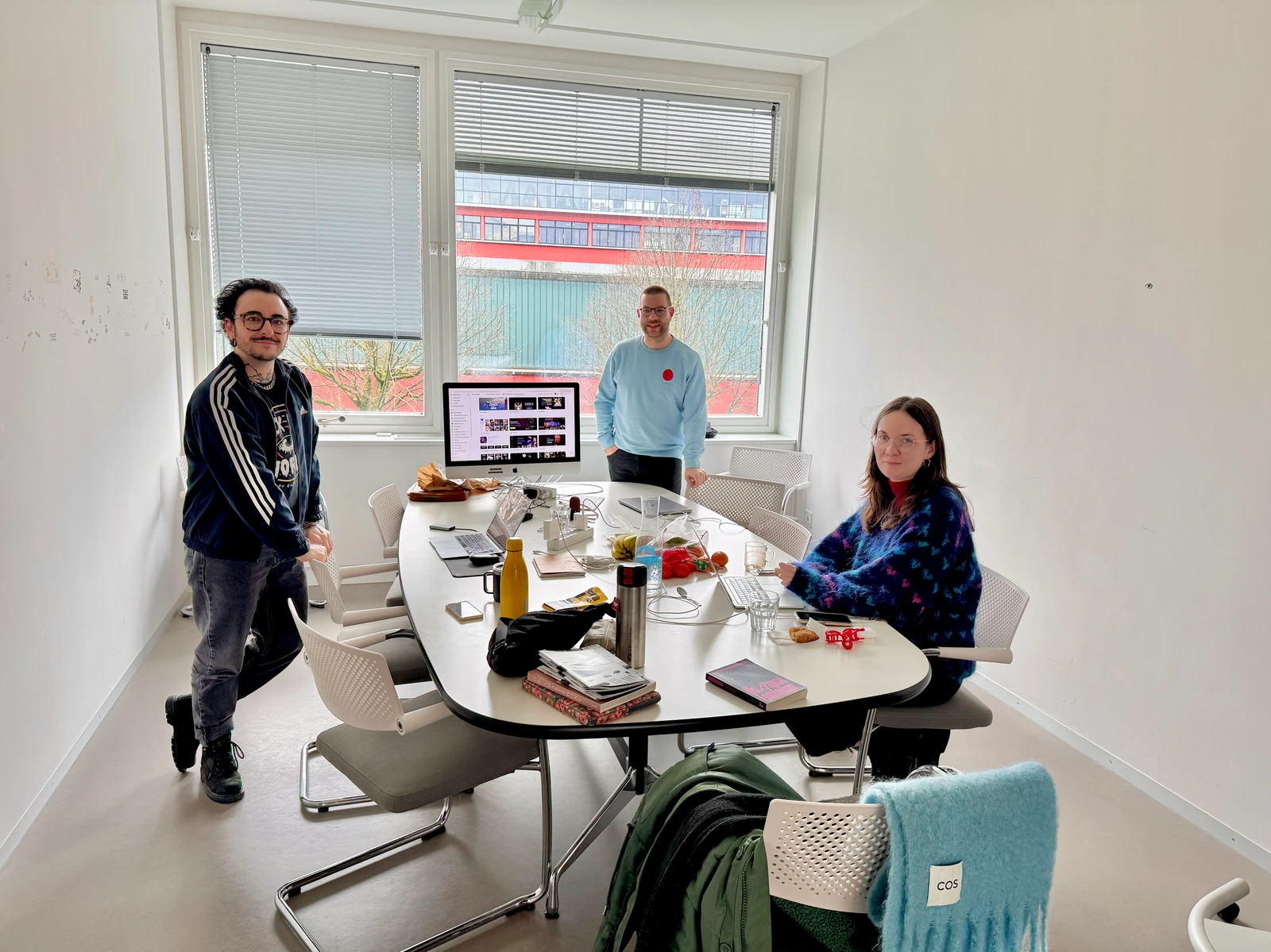
Antonella Autuori, Anthony Masure and Saul Pandelakis gathered in Geneva in February and spent a week generating NSFW content to test Image Generation (GenAI) platforms. → Anthony Masure & Antonella Autuori. This workshop is the second in the Fucking Tech! timeline, which began in October 2024. Following the first workshop spent testing AIGFs (AI Girlfriends or virtual girlfriends), the idea here was to understand the possibilities of generative image AI specifically in the field of pornographic content. → CivitAI interface, an online pornographic content generation service. On the left side of the screen, you can see the “queue” that shows current requests and their processing status. We were particularly interested in prompt writing (descriptions received by the model to generate the image) and developed a methodology that is described in the vlog below, as well as in a visual essay also available for consultation at the end of this post. → Antonella Autuori and Saul Pandelakis busy generating! Ultimately, we generated 400 images in the context of this workshop, and the corpus has since been expanded based on fictions written by Ketty Steward and Elise Bonnard, science fiction authors who are partners in the project.
14 février 2025

Case study – MacPlaymate (1986)

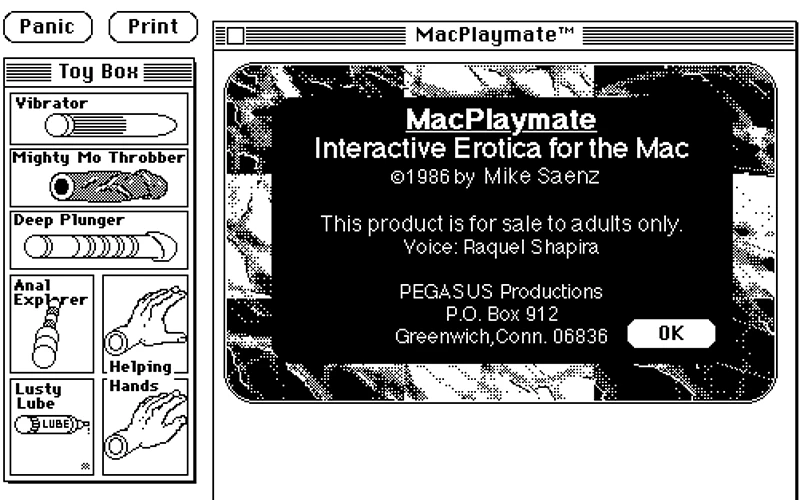
MacPlaymate is a point-and-click game developed by Mike Saenz, CEO of Reactor Inc. During the 1980s and 1990s, he developed and released CD-ROMs, including some of the earliest interactive adult games: MacPlaymate (1986), Virtual Valerie (1990), and Virtual Valerie 2 (1995). Context The artist and software designer began illustrating comics with a computer program shortly after acquiring an Apple Macintosh (1984). He experimented with the Macintosh 512, pushing the limits of what was possible with its limited memory and disk space, drawing inspiration from Playboy magazines. His goal was to create a repetitive and experimental game that would capture players’ attention. In just two weeks, he programmed the erotic and interactive game MacPlaymate. In 1987, Saenz and his associates began selling disks containing the game for $50, ultimately earning $60,000. Due to its popularity, MacPlaymate became one of the most pirated programs of the time, sparking several controversies. Among them were suspicions of unauthorized use by MacroMind (though no legal action was taken) and the game’s use in inappropriate settings. Many male office employees played it at work, prompting complaints from female colleagues, who reported it as sexual harassment and pointed to the emergence of sexist norms in the workplace (Morrison 1988). Ironically, Penthouse and Playboy later drew inspiration from Saenz’s erotic creations, investing in erotic interactive fiction themselves (MEL Magazine 2016). Description The game consists of a series of options that can be used on a character (Maxie/Maxine), featuring a variety of objects and sex toys, animations, lingerie, and potential partners. Everything begins on a screen composed of a toybox, a menu bar, and a display where Maxie is lying down. It is possible to select animations from the “Watch Me” menu (which correspond to different ways for Maxie to masturbate in various outfits). The “Costumes” and “Sexual Partners” menus allow players to change Maxie’s lingerie and her partners (Lola or Melvin). For each animation category, players are encouraged to use the toys from the toybox to bring Valerie to orgasm. There is nothing else to do or explore in the tested version. The sound design (Maxie is voiced by Raquel Shapira) somewhat supports the game’s immersiveness, which is quickly limited by the lack of narrative. Note: The version of the game tested in the context of this study may be incomplete. References: Morrison, Patt. “MacPlaymate: Is It Software or Hard Porn ?” Orlando Sentinel, November 28 1988. MEL Magazine. “Long Before Internet Porn, There Was ‘MacPlaymate.’” September 22 2016. Accessed April 29 2023. Saenz, Mike. Interview by Laura Grindstaff and Julie Palsmeier. “A Conversation with Mike Saenz.” Nideffer.net. Accessed May 22 2025.
25 janvier 2025

Workshop #1 – How Deep is Your Love?

Our first workshop took place in Geneva on the HEAD campus. Anthony Masure, Dominika Čupková and Saul Pandelakis worked together to analyze the offer of “romantic” chatbots. The goal was to test a selection of “ai girlfriends”, i.e conversational agents programmed to provide a romantic and/or sexual experience to its users. We produced a Notion board to sort the AI and guide us through the process. Since then, we added all entries to our ressources section. Then we chatted with 11 services : Kindroid, Blush.ai, Dialogue, Prompchan, Chub.ai, Nastia, RushChat, Replika, OurDream, Kuki and Character.ai. → Screenshot of the Chub.ai app, 2025. → Screenshot of the Eden.ai app, 2025. This vlog gives you a quick look at the week:
29 novembre 2024

Maurice Chalumeau Center Annual Conference, 2024

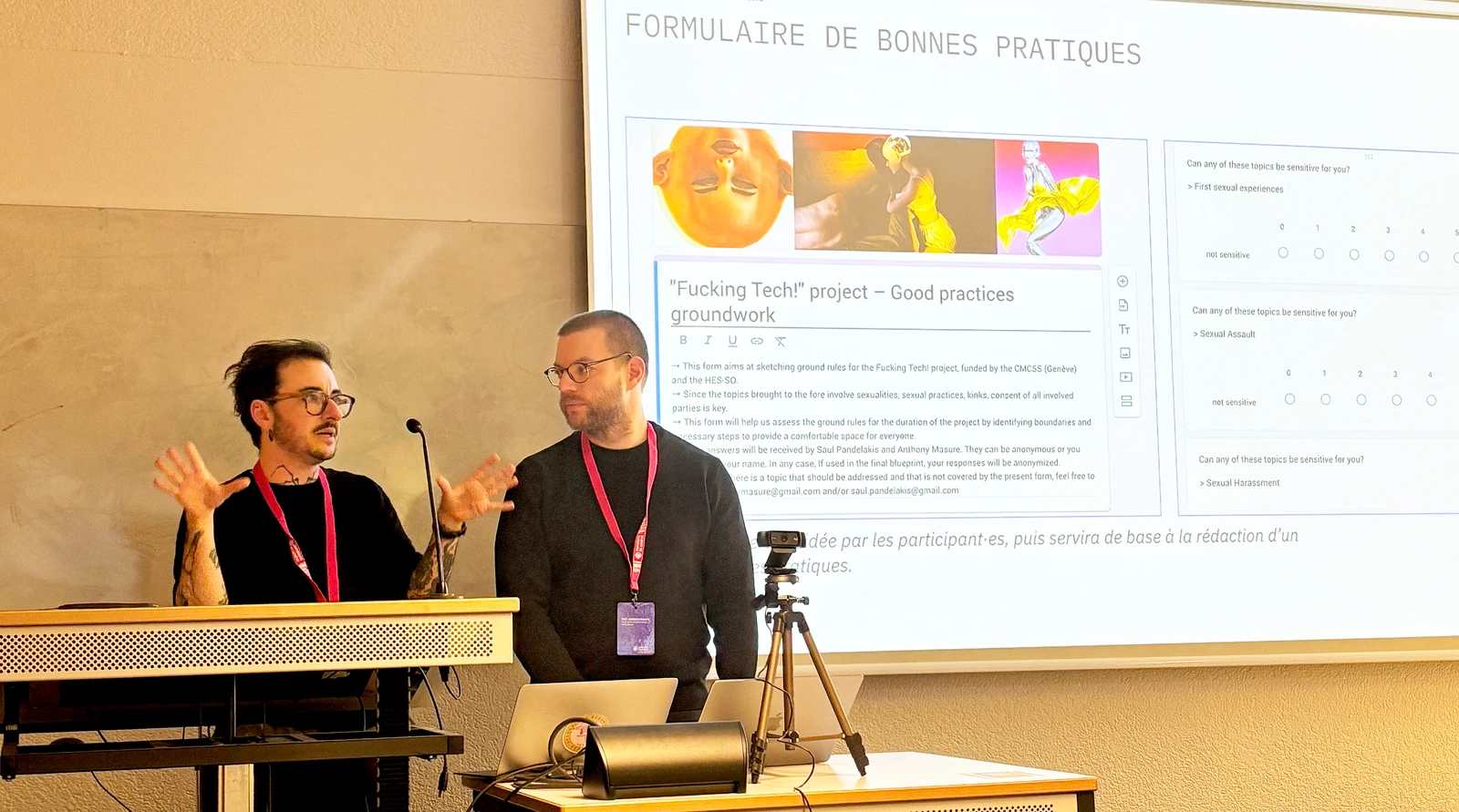
In the fall of 2024, the Fucking Tech! project began and presented its foundations during the research project showcase day on Thursday, November 14, 2024 at the Centre Maurice Chalumeau. The conference started by recalling the project’s origins: research initiated in 2016 on sexbots by Saul Pandelakis and Anthony Masure. After presenting our work at the Contemporary Forms of Computer Imagination conference (University of Montpellier 3) and publishing it in the journal Res Futurae (“Desiring Machines: from sexbots to loving OS”, 2017). We then showed how much the “sex tech” landscape had changed between the research’s beginnings and the 2024 launch of Fucking Tech!. The proliferation of dolls, unclear product landscape, fallacious promises, objects with pedopornographic characteristics… were all discussed during the presentation. We then presented our objectives and deliverables: in year 1, a chatbot that generates erotic stories, StoryTellurX; in year 3, a collective book entitled Terra Incognita Sexualis mapping the possibilities of technologies for sex (sexbots, dolls, specialized AI…) The presentation concluded with an overview of upcoming work stages, including a workshop in January on virtual girlfriends and another in March on generating pornographic images with AI dedicated to this function. Here is how we envisioned our progress in year one:
Bubble

Warning

This project addresses themes related to sexuality, and consent. Please proceed with awareness.

No, I'm 18-

Avertissement

Ce projet aborde des thématiques liées à la sexualité et au consentement. Veuillez poursuivre en connaissance de cause.

Non, j'ai - de 18 ans